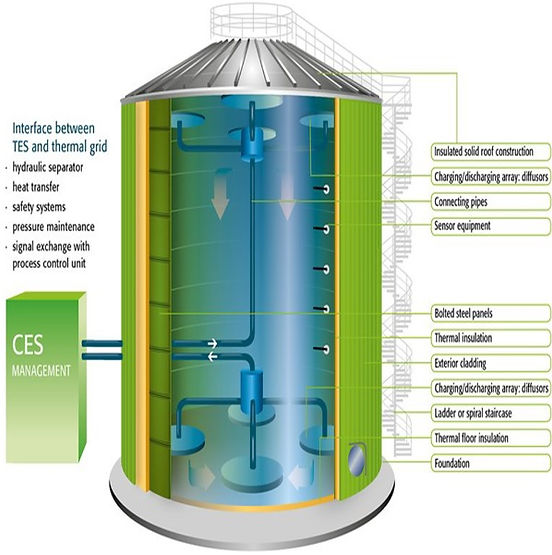

Thermal Energy Storage tank (TES tank)
for Cooling or Heating
TES for cooling
A thermal energy storage tank (TES tank) in cooling/HVAC systems is used to store “cooling energy” usually in the form of chilled water or ice so the building can meet cooling loads more efficiently, reduce operating costs, and improve system reliability.
Below is a clear, practical explanation:
What Is a TES tank
A TES tank is a large insulated vessel that stores cooling energy produced during off-peak hours (typically night). This stored energy is then used during the day when cooling demand and electricity costs are higher.
It is most common in:
District cooling systems
High-rise buildings
Hospitals and airports
Large commercial/industrial facilities
Types of Cooling Thermal Storage:
A) Chilled Water Storage
A large tank filled with chilled water (typically 4–6 °C).
At night, chillers operate to cool the water and “charge” the tank.
During the day, the tank discharges this cold water to the building.
Pros
✔ Simple design
✔ No special heat exchangers
✔ Good for large capacity
Cons
✘ Large tank size
✘ Needs good stratification (temperature layers)
B) Ice Storage
Ice is created at night and melted during the day to supply cooling.
Two main technologies:
Ice-on-coil
Ice harvester
Pros
✔ Much smaller footprint than chilled water
✔ Very high energy storage density
✔ Takes advantage of low night electricity tariffs
Cons
✘ Requires low-temperature chillers (-5 to -7 °C)
✘ More complex controls
Benefits:
Operational benefits
Reduces peak daytime electricity consumption
Smaller chiller size (lower capital cost)
Improves chiller efficiency (night ambient temperatures are cooler)
Adds redundancy/back-up cooling
Financial benefits
Uses low-tariff night electricity
Reduces demand charges by shifting daytime load
In district cooling, reduces plant size and improves efficiency
Environmental benefits
Less stress on electrical grids
Lower CO₂ emissions (if grid is cleaner at night)
How a TES Tank Works in Chilled Water Systems
Night (Charging Mode):
1. Chillers cool water down to ~4–5 °C.
2. Cold water enters the bottom of the tank.
3. Warm return water exits from the top.
4. Tank develops stratification (cold at bottom, warm at top).
Day (Discharging Mode):
1. Warm return water enters the top of the tank.
2. Cold water exits the bottom to the cooling coils.
3. Tank provides chilled water and reduces chiller operation.
Stratification is critical → The tank must maintain clear layers of cold and warm water without mixing.
Typical Applications
Shopping malls
Airports
Hospitals
District cooling plants
University campuses
Commercial towers
Data centers .
High-rise commercial buildings
Hotels and resorts
Design Features of a TES Tank
Internal diffuser ports to maintain stratification
Insulation (to minimise thermal loss)
Large diameter/height ratiod epending on flow stability
Temperature sensors to track stratification layer
Level indicators
Vortex-breakers
Access hatches
Typical Temperatures
Chilled Water Storage: 4–12 °C (ΔT = 6–8 °C)
Ice Storage: Uses glycol or brine, supply around -5 to -7 °C
Control Strategies
Full storage: TES covers almost all daytime load
Partial storage: TES supports peak hours only
Load shifting: Uses TES to reduce electricity demand
Demand limiting: Keeps plant within energy limits
A thermal energy storage (TES) tank is an innovative solution designed to store thermal energy. This technology enhances energy efficiency by you to utilize stored chilled (or hot) water during peak demand times, reducing on additional energy sources. Ideal for both residential and commercial applications, a TES tank can help lower energy costs and promote sustainable practices. Consider integrating a thermal energy storage into your system for a more efficient energy management strategy.
TES for heatling
Thermal Energy Storage (TES) tanks can also be used for heating, not just cooling.
In heating applications, they store hot water or thermal energy to reduce boiler load, stabilize system operation, and shift energy use to off-peak hours. TES Tanks for Heating (Hot Water Thermal Storage)
What Is a Heating TES Tank
A heating TES tank is a large insulated vessel designed to store hot water (typically 60–95°C depending on system type).
It works by charging the tank when heat is available, and discharging it when heating demand increases.
Used in:
District heating networks
Large commercial buildings
Hospitals
Industrial process heating
Systems using heat pumps or boilers
Benefits
Operational Benefits
Reduces boiler cycling (improves efficiency and lifespan)
Provides backup heating capacity
Balances heat pump load
Smooths out peak heating demand
Allows smaller boilers/heat pumps to be installed
Financial Benefits
Use lower-tariff electricity for heat pumps at night
Avoid peak-time gas charges
Reduce size/cost of heating equipment
Environmental Benefits
Works well with renewable energy:
Solar thermal
Heat pumps
CHP systems
Reduces emissions
Improves overall system efficiency
Types of Heating TES Systems
A) Hot Water Storage (Most Common)
Stores hot water at 60–95°C
Stratified tanks to keep hot and cold layers separate
Used heavily in district heating and heat pump systems
Advantages:
Simple
Long lifespan
Low maintenance
Disadvantages:
Large volume required
Heat loss over long periods
B) High-Temperature Storage (Pressurized Water)
Stores water at 120–180°C under pressure
Used for industrial heating and CHP systems
C) Phase Change Material (PCM) Storage
Uses salts or waxes that melt/solidify
High energy density
Smaller tank sizes
D) Molten Salt Storage (Rare for buildings)
Used for large renewable energy plants
Operates at 250–575°C
TES Tank Components for Heating
Insulation (rockwool, PU foam, PIR panels)
Diffusers to keep water layers stratified
Level sensors
Thermocouples
Manholes
Anti-vortex devices
Anti-corrosion lining (epoxy)
Operating Temperatures
System Type | Typical TES Temperature
Building Heating | 60–75°C
District Heating | 80–100°C
Heat Pumps | 45–65°C
Industrial / CHP | 120–180°C (pressurized)
Typical Applications
District Heating
Stores heat from boilers, CHP, or renewable sources.
Heat Pump + TES
TES stores heat produced during low-tariff periods.
CHP (Combined Heat and Power)
Stores waste heat from engines or turbines.
Solar Thermal + TES
Stores solar heat for night-time heating.

Charging mode/
period

Discharging mode/
period